
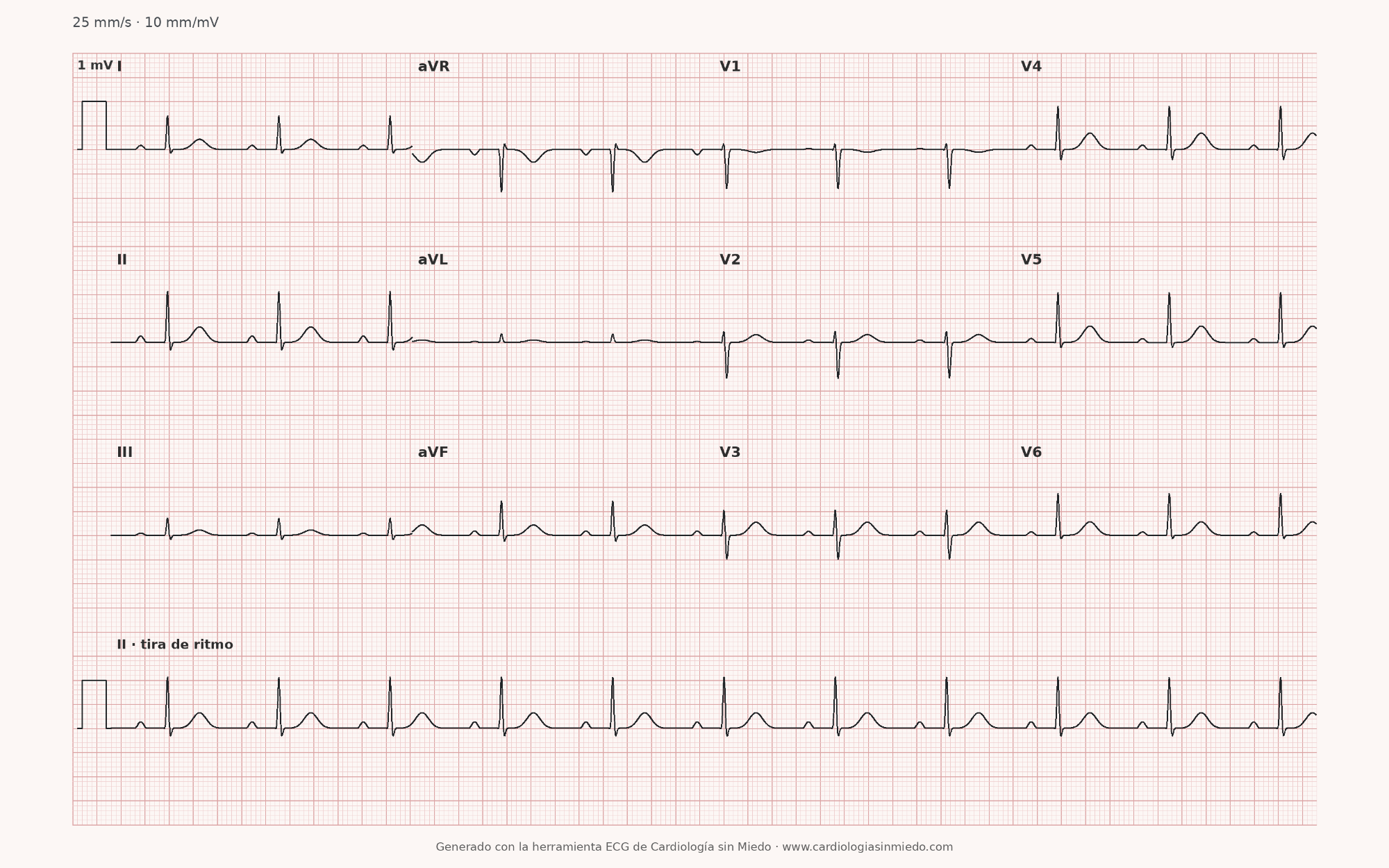
In first-degree AV block no QRS is dropped: every P wave conducts, but takes longer than usual to reach the ventricles.
One P wave for every QRS + PR >200 ms and constant.
This page focuses only on first-degree atrioventricular block. To compare all the degrees in a single sequence, see AV block on the ECG: first, second and third degree.
What is first-degree AV block?
The atrial impulse manages to get through the AV junction in every cycle. The difference is that conduction is delayed. In adults, a PR interval longer than 200 ms with 1:1 conduction and a stable duration is described as first-degree AV block.
At 25 mm/s, 200 ms equals one large box or five small boxes.


How to measure the PR correctly
- Choose a lead where the P wave and QRS are clearly distinguishable, usually II.
- Measure from the start of the P wave, not from its peak.
- Stop at the first deflection of the QRS, not at the top of the R wave.
- Check several beats.
- Confirm that every P wave conducts.
ECG criteria
- P waves with a consistent pace.
- AV relationship 1:1.
- PR >200 ms.
- PR essentially constant from cycle to cycle.
- No blocked P waves.
Why the term “block” can be confusing
In first degree there’s no complete interruption of the impulse. On the ECG we’re seeing an AV conduction delay. The historical name has stuck, but the important teaching idea is simple: everything conducts, just more slowly.
A very long PR can fool you
When the PR is very prolonged, the P wave can sit close to the previous T wave. At first glance it may seem the P wave has nothing to do with the next QRS. The answer is to follow the atrial pace and check whether the P–QRS distance repeats.
Does the QRS have to be narrow?
No. The QRS can be narrow, or wide if there’s also an intraventricular disorder. An associated bundle branch block doesn’t change the criterion that defines first degree: every P wave conducts and the PR is prolonged.
That’s why a combination such as bifascicular block + prolonged PR should be described component by component and not automatically called “trifascicular block”.
Causes and context
The PR interval can lengthen for many reasons. Vagal tone, certain drugs and conduction system disease can all play a part. The ECG identifies the pattern; the cause requires bringing in age, symptoms, medications and structural heart disease.
Differences from other AV blocks
| Pattern | What happens to the PR | Is any QRS dropped? |
|---|---|---|
| First degree | Long and constant | No |
| Wenckebach | Gets longer before the dropped beat | Yes |
| Mobitz II | Stays similar before and after | Yes |
| Complete | No fixed AV relationship | No AV conduction can be shown |
Common mistakes
- Measuring from the peak of the P wave.
- Measuring a single PR without checking other cycles.
- Mistaking a P wave close to the T wave for AV dissociation.
- Believing a long PR means the QRS has to be narrow.
- Calling any prolonged PR with bifascicular block “trifascicular”.
How to write it up in a report
Sinus rhythm with first-degree AV block, PR 240 ms, 1:1 AV conduction.
Practice what you’ve learned
Measure the PR with the ECG calculator and compare different degrees in the ECG generator. Then try the heart block practice cases.
References
- El idioma del ECG (in Spanish). Cardiología sin Miedo. Chapter 12 (in Spanish).
- AV block on the ECG: first, second and third degree. Cardiología sin Miedo.
Last editorial and scientific review: November 22, 2026.
Educational note. ECG interpretation must be combined with the clinical context.
Practice measuring the PR and checking 1:1 conduction in the lesson on first-degree AV block.
Leave a Reply