
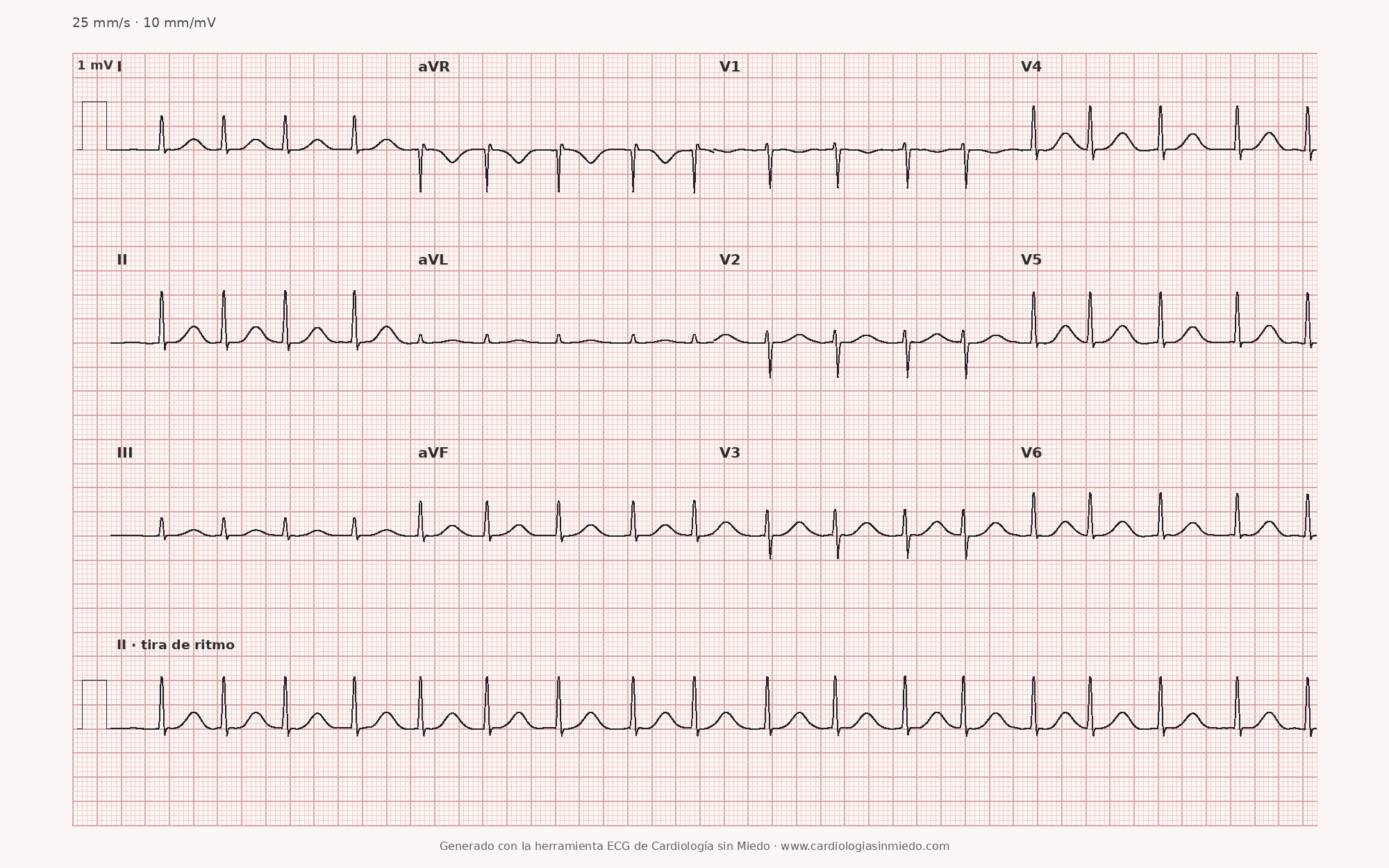
You learn to read ECGs by reading ECGs. That’s why Cardiología sin Miedo now has its own practice tool: a generator of synthetic 12-lead electrocardiograms with 129 teaching patterns and variants and 51,084 configurations verified in the technical audit of version 1.3.0, cases by level and the option to download and print the tracings.
The idea is simple: pick a specific pattern when you want to review it, or take on a case without knowing the diagnosis, analyze it with an orderly method and then check the solution.
It’s a teaching-only tool. The tracings are synthetic, don’t represent real patients and aren’t for clinical diagnosis.
Why we built a generator for practicing ECGs online
Studying electrocardiography with solved examples has a limitation: we often recognize the tracing because we know in advance what we’re looking at.
Things change when a new ECG appears and nobody tells us whether it’s normal, an arrhythmia, a block or a technical problem. That’s where we really find out whether we’ve learned to read the tracing and not just remember a picture.
The generator was created to fill exactly that gap. You can use it as an online ECG simulator, choose what you want to study, or let the tool set up the case and hide the answer.

What you can do with the ECG generator
- Generate synthetic 12-lead ECGs.
- Explore 129 teaching patterns and variants organized in blocks, and generate reproducible variations using a seed.
- Search for a specific pattern to review it.
- Change parameters such as ventricular rate, recording length, speed and gain.
- Practice with the grid and calibration visible.
- Hide the diagnosis and solve the ECG before looking at the solution.
- Pick random cases by difficulty.
- Open the ECG full size to analyze it comfortably.
- Save the tracing as a high-quality PNG.
- Prepare packs of 10 ECGs for practice, with their answer sheet.
The intention isn’t for the generator to replace an atlas or a book. It’s for you to move from theory to practice as many times as you need.
A 12-lead ECG, not just a monitor strip
Many simulators are excellent for training rhythms on a strip or a monitor. Our goal was different: for students to face a complete 12-lead ECG and practice a structured reading.
That lets you analyze not just rate and rhythm, but also the axis, QRS morphology, precordial progression, ST–T changes, the QT and how a finding is distributed across different leads.

How to practice an ECG step by step
One way to get the most out of the tool is to always apply the same sequence. At Cardiología sin Miedo we use our 8-step ECG reading method:
- Technique.
- Rate, regularity and origin.
- Axis.
- P wave and PR.
- QRS and precordial leads.
- ST and T.
- QT/QTc.
- Integration.
Generate a case without showing the solution and make your eyes go through those steps. Only then open the answer and compare your conclusion with the teaching sheet.
Don’t start by asking “which arrhythmia is it?”. Start by asking “what do I see?”.
Study mode: practicing without knowing the diagnosis
Study mode is designed precisely to stop the pattern’s name from giving you the answer before you start.
You can ask for a case by difficulty (beginner, intermediate, advanced or rare patterns) and analyze it without seeing the diagnosis. When you’re done, you reveal the solution and the tool shows a short sheet with the findings you should have identified.
When there’s a specific article on the site, the sheet itself links to the full explanation. That way you can go from case → mistake → explanation → new case without leaving the same learning path.
129 patterns and 51,084 verified configurations
The technical audit combines 129 patterns × 99 seeds × four acquisition profiles: 51,084 verified configurations. These are combinations of parameters, not necessarily different tracings or different diagnoses. The catalog covers the following ECG blocks:
- sinus rhythm, bradycardia and tachycardia;
- atrial fibrillation and flutter;
- premature beats, pauses and escape rhythms;
- AVNRT, AVRT and other tachycardias;
- AV blocks, bundle branch and fascicular blocks;
- ventricular rhythms and tachycardias;
- ST–T changes and ischemia;
- QT abnormalities and electrolytes;
- pacemakers and preexcitation;
- technical errors, electrode placement and dextrocardia.

Download and print ECGs for practice
You don’t always feel like studying in front of a screen. That’s why the tracings can be saved as high-quality PNGs and used outside the browser.
The generator also lets you prepare packs of 10 cases, each ECG on its own page and with a separate answer sheet. This can be useful for studying, preparing a teaching session or handing out exercises without showing the answers from the start.
A generator connected to the whole site
One of the most important parts of the project is that the generator isn’t isolated. The patterns are being linked to the Cardiología sin Miedo articles.
If you’re practicing atrial fibrillation, a bundle branch block, torsades or a premature beat and something doesn’t fit, you can jump straight to the matching explanation and then generate another case.
If you’re just starting out, a good way in is to review the normal electrocardiogram first and then move on to the ECG generator.
The generator and the calculator are designed to work together: create a case in the generator and, when you need to check rate, axis, intervals, QTc or voltages, open the online ECG calculator to compare your measurements.
What this ECG simulator isn’t
The ECGs the tool generates are synthetic teaching tracings. They’re designed to teach patterns and train a structured reading.
They don’t come from real patients, shouldn’t be used for diagnosis and don’t replace clinical assessment, guidelines or experience with real electrocardiograms.
Frequently asked questions about the generator
Can I practice ECGs online without knowing the diagnosis?
Yes. Study mode lets you generate cases by level and keep the solution hidden until you decide to show it.
Is it an online ECG simulator?
Yes, with a teaching focus. Instead of being limited to a monitor strip, it generates synthetic 12-lead electrocardiograms and lets you change recording parameters and practice different patterns.
Can I download the ECGs?
Yes. You can save each tracing as a high-quality PNG and prepare practice packs with ten ECGs and their answer sheet.
Is it only for students?
No. It’s designed mainly for nursing, medical and other health sciences students, but it can also be used for professional review and to prepare teaching exercises.
Last editorial review: November 22, 2026 · About the project
Educational note. The generator’s tracings are synthetic and meant for learning. They don’t represent real patients or replace the clinical interpretation of an ECG.
Practice with a tracing: Review this topic with a synthetic case, then check your reading in the online ECG generator.
If you read Spanish, the complete guide to reading any ECG with the eight-step method is in “El idioma del ECG”.
Leave a Reply