
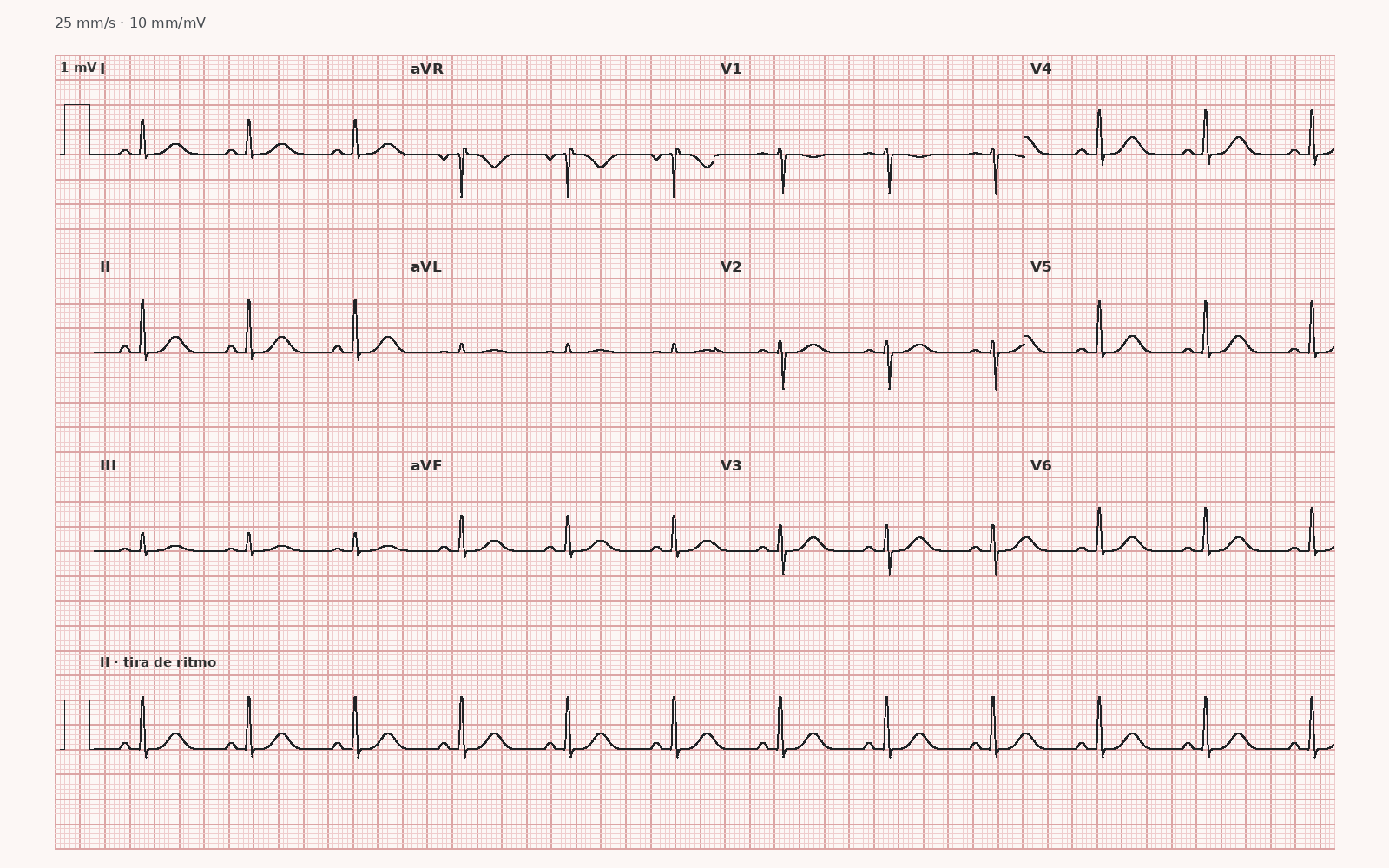
“Sinus rhythm” doesn’t automatically mean “normal ECG”. It means atrial activation starts in the sinus node and follows a recognizable organization on the tracing.
To call a rhythm sinus, look at the P wave first; the rate comes after.
Sinus rhythm is the starting point for reading an ECG. It can occur at a usual, slow or fast rate: the origin is still sinus if atrial activation keeps the expected morphology and an organized relationship with the QRS complexes.
In El idioma del ECG (in Spanish) we use a very simple sequence to recognize it: look for P waves, check their polarity, relate them to each QRS and only then describe rate and regularity.
What exactly does “sinus rhythm” mean?
The sinus node sits high in the right atrium. From there, atrial depolarization travels overall downward and to the left. That direction leaves a useful signature on the ECG:
- Upright P wave in II and usually also in I and aVF.
- Negative P wave in aVR.
- Similar P-wave morphology from one cycle to the next.
- A P wave before every QRS when AV conduction is 1:1.
- Organized P–QRS relationship and a fairly constant PR.

The P wave is the key
A rate of 70 bpm doesn’t make a rhythm sinus. Neither does a narrow QRS. What identifies the origin is, above all, the morphology and polarity of the P wave.
In typical sinus rhythm, the P wave is upright in II and negative in aVR. In V1 it may be biphasic. If the P wave clearly changes axis (for example, becoming negative in II, III and aVF), you have to ask whether the impulse starts in another area of the atrium or whether there’s retrograde activation.
This is the same logic we use in the chapter on rate, rhythm and axis in El idioma del ECG (in Spanish): origin, regularity and rate are different questions.
Does sinus rhythm have to be between 60 and 100 bpm?
No. That range is used to describe a usual resting rate in adults, but the origin can still be sinus outside it.
| Origin | Rate | Possible description |
|---|---|---|
| Sinus | <60 bpm | Sinus bradycardia |
| Sinus | 60–100 bpm | Sinus rhythm |
| Sinus | >100 bpm | Sinus tachycardia |
That’s why “sinus” shouldn’t be used as a synonym for “normal”. A patient can have sinus rhythm and, at the same time, AV block, hypertrophy, ischemia, a prolonged QT or another abnormality.
Sinus rhythm vs ectopic atrial rhythm
In an ectopic atrial rhythm, the impulse starts in an atrial focus other than the sinus node. If that focus is low in the atrium, activation may travel upward and produce negative P waves in the inferior leads.
| Finding | Sinus rhythm | Ectopic atrial rhythm |
|---|---|---|
| P wave in II | Usually upright | May be negative or different from the sinus P wave |
| P wave in aVR | Negative | May change polarity |
| P wave before the QRS | Yes, if conduction is 1:1 | May be yes, with non-sinus morphology |
| PR | Fairly constant | May be constant but with an abnormal P wave |
Regularity alone doesn’t settle the diagnosis. An ectopic atrial rhythm can be perfectly regular.
Sinus rhythm vs junctional rhythm
In junctional rhythms, atrial activation may be retrograde. The P wave can appear before, inside or after the QRS and, when visible, may be negative in the inferior leads. If it appears before the QRS, the PR is usually short because the impulse starts near the AV node.
Review this comparison in Escape rhythms on the ECG.
How to recognize sinus rhythm step by step
- Look for P waves.
- Check that they have a stable morphology.
- Confirm that the P wave is upright in II.
- Check that it’s negative in aVR.
- Look for a P wave before every QRS.
- Check that each P wave conducts if the relationship is 1:1.
- Check that the PR is fairly constant.
- Only then describe the regularity and calculate the rate.
Regular sinus rhythm at 74 bpm. That sentence already tells you the origin, the organization and the rate.
Common mistakes
- Calling any regular narrow-QRS rhythm sinus.
- Looking at the rate before identifying the P wave.
- Treating “sinus rhythm” as a synonym for “normal ECG”.
- Ignoring a negative P wave in II, III and aVF.
- Mistaking a retrograde junctional P wave for a sinus P wave.
- Not checking electrode placement when the polarity doesn’t make sense.
Related articles
References
- El idioma del ECG (in Spanish). Cardiología sin Miedo. Chapter 6: “Rate, rhythm and axis: the first three answers” (in Spanish).
- Kashou AH, Basit H, Chhabra L. Electrocardiogram. StatPearls.
- III SBC Guidelines on the Analysis and Issuance of Electrocardiographic Reports. Executive summary.
Last editorial and scientific review: November 22, 2026 · About the project
Educational note. This article explains ECG recognition criteria. The final interpretation must be put together with the clinical context.
Keep learning: review this concept in lesson 8 on rate and origin of the rhythm. All lessons are free, and afterward you can practice with the ECG generator.
Leave a Reply